Karakoram-2026: How China and Pakistan are deepening military ties — and what it means for India
China and Pakistan’s longstanding partnership, while not a formal alliance, has emerged as a defining feature of the regional security architecture.
Over the years, their military cooperation has deepened, moving beyond defence acquisitions and joint exercises towards greater functional integration and interoperability.
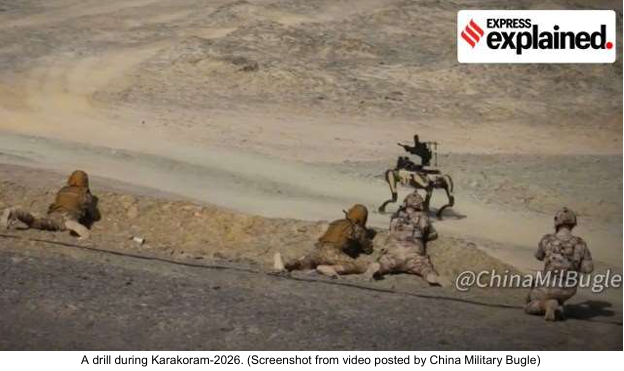
In this context, the countries’ recently concluded joint exercise, Karakoram-2026, marked a significant milestone — it involved the participation of regular army formations from both countries. Notably, the exercise was conducted in Xinjiang, which borders Jammu & Kashmir and Ladakh.
Why the Karakoram-2026 exercise matters
Karakoram-2026, held from October 14-22 in the Xinjiang Uyghur Autonomous Region, was the first joint-army level exercise between People’s Liberation Army (PLA) and Pakistan Army. It expanded on the earlier naval, air and counterterrorism exercises (Sea Guardian, Warrior and Shaheen series). The focus was on challenging high-altitude operations, relevant to the PLA’s Western Theatre Command which oversees the border with India.
Phase One of the exercise, up to October 19, involved troops from both sides practicing specialised tactics, close-quarter combat and unmanned aerial vehicle (or drone) operations. Phase Two entailed joint command, mixed formations and combat teams undertaking counterterrorism clearance operations, joint manoeuvres and coordinated fire drills.
The equipment used was Chinese, including small arms, armoured assault vehicles, infantry fighting vehicles and support systems, such as artillery, drones and anti-manned systems. The Chinese Ministry of National Defence described Karakoram-2026 as an opportunity to deepen cooperation and tactical integration between the two armies.
The China-Pakistan Nexus: Its genesis and core pillars
The China-Pakistan nexus refers to the longstanding strategic, economic and military partnership between the two countries. It dates to the 1963 Sino-Pakistan Boundary Agreement under which Pakistan ceded the Shakasgam Valley, part of Gilgit-Baltistan, to China, thus cementing the strategic alignment.
The subsequent decades witnessed China’s growing role in building Pakistan’s nuclear and missile programme which altered the regional strategic balance and security dynamics, primarily hedging against India. Today, China treats Pakistan a strategic priority, central to its South Asia policy.
The core pillars of China-Pakistan nexus are:
– Military supplies: China is Pakistan’s dominant arms supplier, accounting for roughly 70-80% of its imported military hardware. Major acquisitions include J-10C and JF-17 fighter aircrafts, Type 054 A/P frigates, Hangor-Class Submarines, HQ-9, 16, 17 series air defence systems, and Wing Loom drones.
– Defence co-production: Both nations regularly collaborate on co-producing military equipment including fighter jets (J-10C and JF-17), main battle tanks (Al-Khalid), missiles, naval platforms, electronic and surveillance systems. Pakistan gets access to advanced technology while China gets to consolidate its defence-industrial outreach.
– Information: Information and space are other arenas of close cooperation; encompass intelligence sharing, cyber warfare, satellites (Bei Dou for navigation) and information cum narrative alignment, through initiatives like China-Pakistan Information Corridor.
– Infrastructure: The collaboration extends to infrastructure and strategic projects such as the China-Pakistan Economic Corridor (CPEC) and Gwadar Port under the Belt and Road Initiative (BRI).
– Drills: The two countries regularly conduct bilateral and multilateral drills; the scope has significantly enlarged over the years.
Expanding architecture of military cooperation
The Karakoram-2026 exercise must be viewed against the expanding profile of the China-Pakistan defence cooperation — from a buyer-supplier arrangement towards deeper military integration. It follows a joint patrol conducted by Chinese and Pakistan security personnel at Mantika Pass, at an altitude of 4,700 metres (near Khunjrerab Pass), in the upper Hunza area of Gilgit-Baltistan, reflecting the operationalisation of the border management mechanism and a growing Institutional engagement.
In May 2025, when India launched aerial strikes (Operation Sindoor) targeting terrorist infrastructure in Pakistan, the collusion between Beijing and Islamabad came into sharp focus. There was strong evidence that China accelerated the deliveries of PL-15 E air-to-air missiles, air defence and electronic platforms into Pakistan’s military structure during the crisis.
Lt Gen A S Chaudhary, Director General of Pakistan’s Inter-Services Public Relations, had claimed in an interview with Bloomberg that China-made weapon systems performed extremely well during the four-day conflict with India.
The change of government in Bangladesh also adds a new dimension to defence and diplomatic ties in the region. Islamabad, Dhaka and Beijing may not have formed a strategic trilateral, but they are leveraging the China-Pakistan strategic framework.
Bangladesh has advanced plans to purchase J-10CE fighter jets from China and its pilots will be trained by Pakistan at Jessore airbase, near the Siliguri corridor. There are also discussions regarding integration of air defence radar systems and upgrading Bangladesh tank fleet with Chinese technology and Pakistani expertise. High-level exchanges between the Pakistani and Bangladesh militaries are a distinct departure from the past isolation.
Strategic implications
Karakoram-2026 takes the China-Pakistan relationship a step further. Beyond equipment familiarisation, the joint training facilitates the exchange of operational experience, standardisation of procedures, command and control coordination and interoperability. Incidentally, there are intelligence reports that Pakistan Army officers are posted in key Chinese military formations in the PLA’s Western Theatre Command and Joint Staff Department of the Central Military Commission (CMC).
The significance of Karakoram-2026 lies in the changing character of the China-Pakistan military cooperation. The joint training of mixed formations, growing integration of the Chinese platforms into Pakistan’s military inventory and increasing military engagement in the Xinjiang-Karakoram region have critical strategic significance. India needs to closely monitor the evolving China Pakistan military relationship, both as an integrated two-front challenge and in the larger regional context.
The expanding China-Pakistan nexus, therefore, compounds India’s security threat on the Northern border. For Delhi, the challenge is no longer just to contend with two adversarial neighbours but to prepare for the strategic consequences with a coherent national security strategy that addresses the convergence of Chinese and Pakistani military capabilities.
The author is a war veteran, former Assistant Chief of Integrated Defence Staff, and served as Defence Attache in China. He is currently professor at Lal Bahadur Shastri Institute of Management.