Opinion | US National Security Strategy-2025 Signals A New Era of Global Politics
Balancing ties while demanding reciprocity, disrupting supply chains without economic shock, and deterring adversaries without escalation will test Washington’s diplomatic finesse. The US National Security Strategy (NSS)-2025 marks a pronounced doctrinal shift, from America’s erstwhile global leadership-alliance centric security architecture to hard nosed power politics. The 33-page document articulates Washington’s strategic reorientation, in sync with President Trump’s vision of “America First”. It defines the roadmap, a concrete, realistic plan that explains the “essential connection between ends and means”, to ensure that the US remains the world’s strongest, richest, most powerful, and most successful country for decades ahead.
The document begins with the assertion that national security starts at home; hence, it accords utmost priority to defending the borders, critical infrastructure, and resources. Immigration is perceived as the core of national security, evident from the declaration that the “era of mass migration is over”. Uncontrolled migration reflects anxieties over demographic shift, posing a serious risk with socio-political implications. At the same time, the strategy envisages America fielding the world’s most powerful, lethal, and technologically advanced military to protect national interests, deter wars, and—if necessary—win these quickly and decisively, with the lowest possible casualties. It also encompasses a credible and modern nuclear deterrent, plus next generation missile defences, including Golden Dome for the American homeland.
Economic nationalism is the next important pillar of the NSS—it implies strategic repositioning, encompassing re-industrialisation by shoring up domestic manufacturing capacity and technology security, a prerequisite for national resilience. Additionally, it also entails de-risking and decoupling from competing economies to obviate strategic vulnerability, especially in the fields of semiconductors, rare earth minerals, pharmaceuticals, and energy. Further, the security policy document underlines the quest for technology primacy with unquestionable leadership in AI, quantum technologies, biotechnology, cyber, and space, besides advanced defence platforms. To achieve “integrated deterrence”, the strategy visualises combining military might with technological and economic levers to present a shield against adversaries operating in the Grey Zones. Cyberattacks, AI-orchestrated disinformation, and satellite disruption, henceforth, will be treated with the same gravity as missile strikes.
It is America’s foreign policy that is set for the most consequential makeover as it sheds the role of being a global policeman and adopts a theatre-based approach, giving due priority to national interests. The Western Hemisphere is designated as the US primary region, which reinforces “Trump’s Corollary” to the “Monroe Doctrine”. It implies ensuring a stable neighbourhood, besides politico-economic and maritime dominance of the region by keeping rivals out. Preserving the freedom and security, restoring civilisational identity, and restoring self-confidence of Europe are considered vital, given the failure of NATO’s strategy against Russia. The US core interest is to negotiate an expeditious cessation of hostilities in Ukraine to stabilise the European economies and also re-establish strategic stability with Russia. Washington expects burden sharing and higher defence expenditure by Europe as a security ally and partner. The transactional tone has sparked unease in the European capitals, raising doubts about the centrality of the transatlantic partnership.
Meanwhile, keeping the Indo-Pacific free and open and preserving freedom of navigation are deemed to be crucial to reverse the damage to the American economy. The region features as the arena of intense competition, with China being the main strategic challenger, not necessarily militarily but for technological supremacy, trade, and control of supply chains. With containment of China being no longer a sustainable option, the strategy seeks to avoid conflict and maintain mutually beneficial economic relations given the interdependence. Simultaneously, the document seeks to balance Beijing’s influence through calibrated deterrence by consolidating relations with trusted partners and allies. The NSS clearly states that it “does not support any unilateral change in the Taiwan Strait”. To this end, President Trump recently signed the “Taiwan Assurance Implementation Act”, enacting it into American law.
The West Asia region, once a pivot of American power projection and energy security, stands downgraded with diminished priority. Given the US’s increasing energy self-sufficiency, the engagement is likely to further scale down. Concurrently, the NSS seeks to prevent an adversarial power from dominating the Middle East oil-gas supply lines while avoiding “forever wars” that bogged down the US at a great cost. The US involvement in Latin America is expected to be deeper, particularly involving trade, energy, narcotics, and border management to check migration.
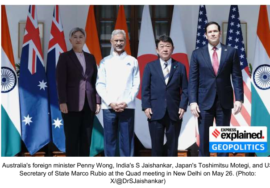
For South Asia, American attention is selective, yet the NSS acknowledges India’s role as the Quad partner in maintaining strategic balance in the region. However, Delhi’s erstwhile role as a counter to Beijing gets truncated. While political relations have lost the erstwhile goodwill and a trade agreement is still to be negotiated, the strategic partnership and defence ties between Washington and Delhi remain strong. The US-India “defence cooperation framework” guiding long-term defence ties was signed in October this year. Military equipment purchases, be it MH 60 Sea Hawks, Apache 64 helicopters, or GE F404 engines, remain on track, delays notwithstanding. What is of serious concern for India is the strengthening of US-Pakistan relations under Trump’s personal patronage, which is likely to embolden Rawalpindi. Not being a US ally gives Delhi space to engage in multiple partnerships to build its military capacity.
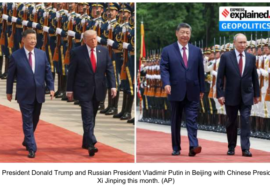
Taking a reality check, while the NSS is neither isolationist nor interventionist, American opinion is divided over it. Those in support hail the document, as they argue that limitless global engagement drains resources that can be optimally used to strengthen domestic capability. Critics, on the other hand, counter that the US renouncing its global role will lead to fragmentation of the world order due to inter-power rivalries. In the event of America stepping back, confining itself to the Western Hemisphere, China is likely to fill the vacuum and run Asia, in sync with Trump’s grand vision of G2 or maybe even G2 plus 1 (incorporating Russia).
The US strategic shift has far-reaching implications. For China, the competition intensifies; beyond military, it includes technology and trade. As far as Europe is concerned, strategic autonomy is no longer a choice but an imperative. Despite current strains, India still remains vital for US strategic interests. For the global polity, the message is rather stark, i.e., US commitment will be calibrated, interest-based, and transactional.
Balancing alliances while demanding reciprocity, disrupting supply chains without economic shock, and deterring adversaries without escalation will test Washington’s diplomatic finesse. Undeniably, the NSS-2025 signals a new era in the global politics of selective engagements, marked by rebalancing of power dynamics, technological arms races, economic fortification, and guarded borders. Willy-nilly, the global order is in for serious disruption—the defining feature will be fluid alignments and contested multi-polarity under the overarching bipolar shadow.
The author is a War Veteran; former Assistant Chief, and currently Professor Strategic and International Relations. Views expressed in the above piece are personal and solely those of the writer. They do not necessarily reflect News18’s views.